
Cash Flow for Doctors: Seven Strategies to Create Clarity and Control
Apr 30, 2025
Introduction
Managing your cash flow is the foundation of financial stability and freedom. Without consistent cash flow, even a high income won’t guarantee long-term security. Think of cash flow as the heartbeat of your finances—essential for keeping everything else running smoothly.
Do you often wonder where your paycheck disappears each month? Between high student loans, fluctuating income, and long hours, managing money as a doctor can feel overwhelming. The good news? Cash flow management for doctors is the key to reducing stress and building lasting financial security.
This post is your roadmap to success. You’ll learn practical strategies to cut unnecessary expenses, diversify your income through side gigs, and automate savings—ensuring you can regain financial control without disrupting your busy schedule.
In this post, you’ll find:
- Simple tools to easily track your finances.
- Steps to boost your income with minimal effort.
- Proven methods to stay consistent through automation.
Let’s dive into these actionable tips and help you regain control of your financial future.
TL; DR
- Why it matters: Cash flow is essential for doctors to achieve financial stability.
- Challenges: High debt, irregular income, and time constraints.
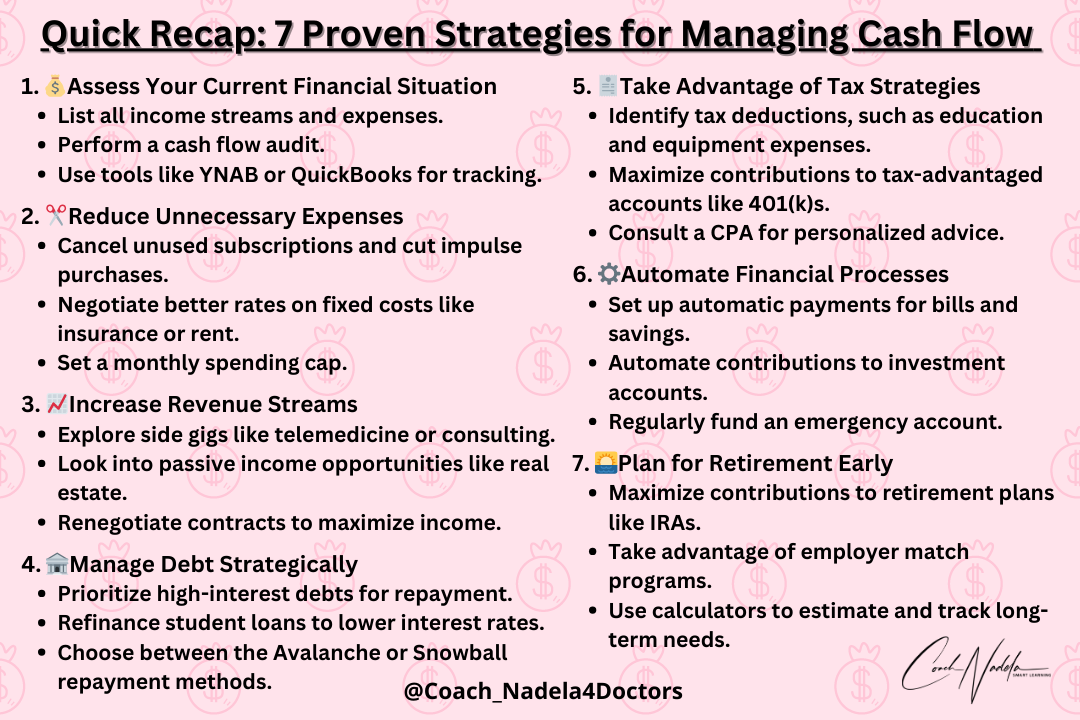
- What’s inside: Seven easy, effective strategies to manage cash flow and grow your financial health.
1. Assess Your Current Financial Situation
Begin with facts, not assumptions. List every income source and review at least three months of bank and credit-card activity. Separate fixed commitments, variable essentials, discretionary spending, debt payments, savings, and investments.
If income varies, identify a dependable base amount and treat bonuses, call pay, partnership distributions, or other irregular income separately. If bill timing creates pressure even when total monthly income is sufficient, use a cash-flow calendar. The CFPB’s cash-flow budget tool focuses on the timing of income and expenses from week to week.
Compare what your records show with what you expected. The difference often reveals the real issue: irregular large expenses, annual premiums, professional fees, tax payments, forgotten subscriptions, or transfers that were never clearly assigned to a goal.
Why it matters: You cannot improve cash flow reliably until you understand both the amount and timing of Money In and Money Out.
Next Step: Schedule a 30-minute Financial Vital Signs review and calculate your average monthly surplus over the last three months.

2. Reduce Unnecessary Expenses
Improving cash flow is not about shame or removing everything enjoyable. It is about distinguishing what supports your life from what continues by habit.
Review the largest recurring commitments first: housing, vehicles, insurance, education, childcare, travel, and debt payments. A small change in a large category can matter more than dozens of minor cuts. Then review quieter leaks such as unused subscriptions, duplicate services, recurring professional tools, convenience fees, and renewals.
Also plan for predictable but irregular costs. Licensing, professional dues, insurance premiums, holidays, travel, home repairs, and annual taxes are not emergencies simply because they do not occur monthly. A separate reserve for these expenses can make cash flow calmer and more accurate.
Why it works: Spending becomes easier to manage when it reflects deliberate priorities instead of accumulated defaults.
Next Step: Identify one expense to eliminate, one to renegotiate, and one irregular cost that needs a monthly reserve.
3. Increase Revenue Streams
Cash flow can improve through income as well as spending. Start with your current role: understand your compensation formula, benefits, call arrangements, productivity measures, partnership terms, and whether a negotiation is appropriate.
Additional clinical work, locum assignments, telemedicine, teaching, consulting, research, expert review, or practice ownership may create new income. Evaluate each option after taxes, expenses, professional-liability requirements, contractual restrictions, travel, administration, and time away from health or family.
More income does not automatically improve finances if it immediately becomes new recurring spending. Decide in advance how additional income will be divided among taxes, enjoyment, reserves, debt, investing, and other goals.
Why it works: A sustainable increase in net income can accelerate priorities without requiring permanent austerity.
Next Step: Evaluate one potential income opportunity using five questions: How much net cash? How much time? What costs? What risks? Which priority will it fund?

4. Manage Debt Strategically
Debt affects both monthly flexibility and long-term net worth. Build one complete debt table showing balance, interest rate, minimum payment, remaining term, whether the rate changes, and any protections or forgiveness possibilities.
High-interest debt often deserves priority, but the right sequence depends on the complete situation. Compare the interest savings from extra repayment with the need for emergency reserves, an employer retirement contribution, or another urgent goal. Avalanche and snowball approaches can both work; the most useful method is one you understand and can sustain.
Be careful with refinancing. A lower payment may result from a longer term rather than a lower total cost. Refinancing federal student loans into a private loan can also permanently remove federal repayment, deferment, discharge, or forgiveness features. Review the complete tradeoff before acting.
Why it works: A written strategy prevents each debt from competing for attention and cash at the same time.
Next Step: Choose the next debt priority and define the monthly amount, review date, and conditions that would cause you to change the strategy.
5. Take Advantage of Tax Strategies
Tax planning is not about chasing deductions. It is about understanding how compensation, side income, business activity, investment income, retirement contributions, withholding, and estimated payments interact in your situation.
Keep an organized record of tax documents and potentially deductible professional or business expenses, but do not assume an expense is deductible simply because it relates to medicine. Eligibility depends on employment status, entity structure, jurisdiction, and current rules.
If you receive W-2 income, the IRS Tax Withholding Estimator can help assess federal withholding. Doctors with self-employment, practice, partnership, or multiple income sources should coordinate estimated payments and planning with a qualified tax professional.
Retirement accounts may offer tax advantages, but plan types, eligibility, contribution limits, and tax treatment change. Confirm current information through the IRS retirement-plan guidance, your plan administrator, and your tax professional.
Why it works: Planning throughout the year reduces surprises and helps you make decisions while options are still available.
Next Step: Schedule a tax-planning review before year-end and bring a summary of every income source, retirement contribution, and major financial change.

6. Automate Financial Processes
Automation reduces the number of recurring decisions competing for your attention. It can help you pay bills on time, build reserves, invest consistently, and move money toward priorities before it is absorbed elsewhere.
Automate only after confirming the amounts and timing. Keep enough buffer in the payment account, align due dates with income where possible, and set alerts for low balances or unusual transactions. Automation should support awareness—not replace it.
A simple system may include automatic bill payments, a scheduled transfer to the Peace of Mind Fund, retirement or investment contributions, and separate reserves for annual expenses. Review the system monthly and after any significant income or expense change.
Why it works: Good automation converts your Financial Plan into a repeatable process.
Next Step: Automate one priority this week and create a monthly reminder to confirm that all transfers still fit your cash flow.
7. Plan for Retirement Early
Retirement planning begins with the life you want—not with a universal savings percentage. Consider when you may want to reduce or stop clinical work, where you might live, how you expect to spend your time, and which expenses or responsibilities may continue.
Then connect that vision to today’s cash flow. Review workplace plans, employer contributions where available, IRAs and other applicable accounts, and the amount you can contribute consistently while balancing current obligations. The appropriate investment mix depends on timeframe, risk tolerance, and the rest of your Financial Plan.
Contribution limits and tax rules change, so verify current figures rather than relying on a fixed number in an older article. Review progress at least annually and after major life or career changes.
Why it matters: Regular contributions made over time give your future more flexibility, while a plan helps you avoid sacrificing life today for a retirement you have not defined.
Next Step: Write a one-paragraph description of your desired retirement and calculate how much of your current monthly surplus is intentionally supporting it.

Conclusion
Strong cash flow is not about restriction. It is about visibility and choice. When you understand Money In and Money Out, remove spending that no longer serves you, coordinate debt and taxes, automate purposeful actions, and connect today’s income with future goals, you create greater Financial Clarity and control.
Begin with one month, one priority, and one action. Then review the system regularly. Small improvements become meaningful when they are repeated and connected to your own Financial Plan.
If you would like a simple educational foundation, start with the free course The Financial Doctor: Smart Money for Smart Medics.
If you would like help clarifying where your money is going and what to prioritize next, book a no-pressure complimentary Financial Clarity Call.
Educational disclaimer: Coach Nadela provides financial education and coaching. He is not acting as your financial advisor, investment manager, tax professional, attorney, or insurance agent; he does not manage investments or sell financial products. This article is general education, not individualized financial, investment, tax, legal, or insurance advice. Consult appropriately qualified professionals for recommendations specific to your circumstances.
Stay healthy, stay wise. 💚
Coach Nadela
Financial Coach for Doctors